
Make
Visual scenario builder for complex multi branch automations across thousands of apps, with AI agents.
Best for Complex visual workflows at low per operation cost
What it does
Make is a visual automation platform that lets you create automated workflows and AI agents. You put in data and triggers from your applications and get out automated actions, data transformations, and updates across connected tools. It is designed for teams and organizations deploying automation and AI across their business without requiring custom development.
Read more: 5 features and how people use themShow less
-
Visual scenario builder
Enables you to map processes by dragging and dropping modules, creating routes, and defining actions on an interactive visual canvas.
Use caseA digital process improvement manager connects dealership software to internal company infrastructure to move data between systems.
From make.com -
Out of the box integrations
Connects thousands of standard business applications and custom APIs to read, write, search, and trigger data transfers.
Use caseA business manager reads a new record from Pipedrive, writes it as a new row in a Google Sheet, and sends the updated information to Airtable.
From make.com -
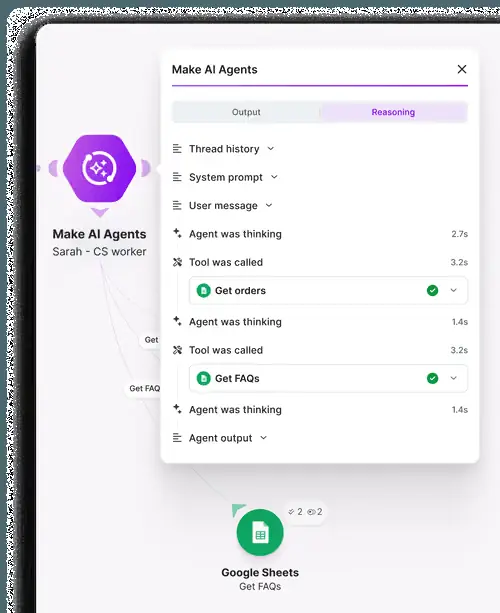
Guided AI workflows
Follows a defined step by step path while applying AI reasoning to specific judgment calls along the run.
Use caseA workflow creator sets a defined routing path and relies on an AI model to make context decisions.
From make.com/product · image from Make -
Error handlers and execution history
Manages execution failures through automated retries, exception routing paths, and detailed visual histories detailing which specific step broke.
Use caseA workflow builder reviews a failed run to inspect which module stopped working and applies a break or resume module.
From make.com/product -
Make Grid governance
Provides an organization wide dashboard displaying all active workflows, their execution status, ownership details, and historical audit logs.
Use caseAn enterprise administrator monitors all company automations and sets role based permissions to control who can edit workflows.
From make.com/product
Written from Make's own website, checked . Each feature links to the page it comes from; images are Make's own.
Every plan
| Plan | Monthly | Billed yearly | Per | What it includes |
|---|---|---|---|---|
| Free | Free | Not listed | per account | 1,000 credits/month, 2 active scenarios, 15 min interval, 7 day logs |
| Core | $10.59 | $9 | credits (10k tier) | 10k credits/month (slider to 8M+), unlimited scenarios, 1 min interval, Make API 60 calls/min |
| Pro | $18.82 | $16 | credits (10k tier) | 10k credits, priority execution, custom variables, full text log search |
| Teams | $34.12 | $29 | credits (10k tier) | 10k credits, teams and roles, shareable templates, 500 MB file size |
| Enterprise | Contact sales | Not listed | custom | contact sales |
From Make's own pricing page, checked . Prices are in US dollars per month; "billed yearly" is the monthly price when you pay for a year up front. A few figures (often the yearly price) are derived rather than printed on the page.
Before you pay
- Card needed for the trial
- No
What Make says
The free plan includes enough credits and active scenarios to build and run real automations, with no card required.
Source page - Unused credits roll over
- No
- Data retention
- By default, log data is stored for 30 days, with options for extended storage on the Enterprise Plan.
What Make says
By default, log data is stored for 30 days. In our Enterprise Plan, we also offer the ability to store data for an extended period.
Source page - SOC 2
- Yes
What Make says
Make is GDPR compliant and SOC 2 Type II and SOC 3 certified, with encryption, SSO, role based access and audit logs.
Source page - GDPR
- Yes
What Make says
Make is GDPR compliant and SOC 2 Type II and SOC 3 certified, with encryption, SSO, role based access and audit logs.
Source page - Discounts
- Discounts are available for annual upfront payments, startups (50% off Business for under 20 employees), and non profit organizations (NGOs/NPOs).
What Make says
Under 20 employees? Check if you qualify for our Start up Plan and get 50% off Business.
Source page
Only what Make's own pages state, with the quote behind each answer. Anything they don't publish is left out rather than guessed.
Make video tutorials
Independent creators on YouTube, not Make or us. The video loads from YouTube only when you press play.
What the free plan includes
1,000 credits/
Questions people ask about Make
How much does Make cost?
Paid plans start at $10.59 a month (Core). 5 plans are listed above, from Make's own pricing page.
Is Make free?
Yes, there is a free plan: 1,000 credits/month, 2 active scenarios, 15 min minimum interval, 5 min max execution.
Do unused Make credits roll over?
No, unused credits do not carry over to the next month. Source
Do I need a credit card to try Make?
No, you can start without a credit card. Source
Does Make have a student or other discount?
Discounts are available for annual upfront payments, startups (50% off Business for under 20 employees), and non profit organizations (NGOs/NPOs). Source
Does Make have an API?
Yes.
Is there a free plan?
Yes. The free plan includes enough credits and active scenarios to build and run real automations, with no card required. Source
What happens with unused credits at the end of the term?
Credits expire at the end of the term. Source
What forms of payment do you accept?
For the Core, Pro, and Teams plans, Make accepts all major credit cards, ACH direct debit, and Google Pay, as well as wire transfer after invoice for enterprise customers. Source
Works with
- AI models
- Claude, ChatGPT, Gemini, Whisper
Where this came from
Plans, prices and limits were copied from Make's own pages and the other sources listed, then checked .
- make.com/en/pricing
- jetadmin.io/blog/make-pricing/
- make.com/en/security
- make.com/
- make.com/pricing
- make.com/success-stories/how-make-helped-dude-wipes-build-a-culture...
- make.com/security
- make.com/success-stories/make-helps-finn-empower-teams-to-innovate-at-speed
- make.com/integrations
How we collect prices and rank tools · Is something wrong? Correct this listing
Others that do the same job
 Zapierzapier.com
No code automation platform connecting 9,000+ apps with multi step Zaps, tables, forms and AI agents.
- Green flag: Free plan
 Activepiecesactivepieces.com
Open source Zapier alternative with flows, AI agents, tables and MCPs, self hostable on every plan.
- Green flag: Free plan
- Green flag: No card for trial
 Integratelyintegrately.com
Budget no code automation with millions of ready made one click automations across 1,500+ apps.
- Green flag: Free plan
 Microsoft Power Automatemicrosoft.com/en-us/power-platform/products/power-automate
Microsoft's cloud and desktop RPA automation platform with Copilot and agents across Microsoft 365.
 IFTTTifttt.com
Consumer friendly applet automation linking 1,000+ apps, smart home devices and services.
- Green flag: Free plan
 n8nn8n.io
Fair code workflow automation with AI agent nodes, code steps, and free self hosted Community Edition.
- Green flag: Free plan
- Green flag: No card for trial
- Red flag: Credits reset monthly